To control invisible gas flows and complex chemical reactions, we leverage cutting-edge computational tools and intelligent algorithms, bridging the gap between theoretical modeling and real-world application.
Multi-physics CFD Simulation
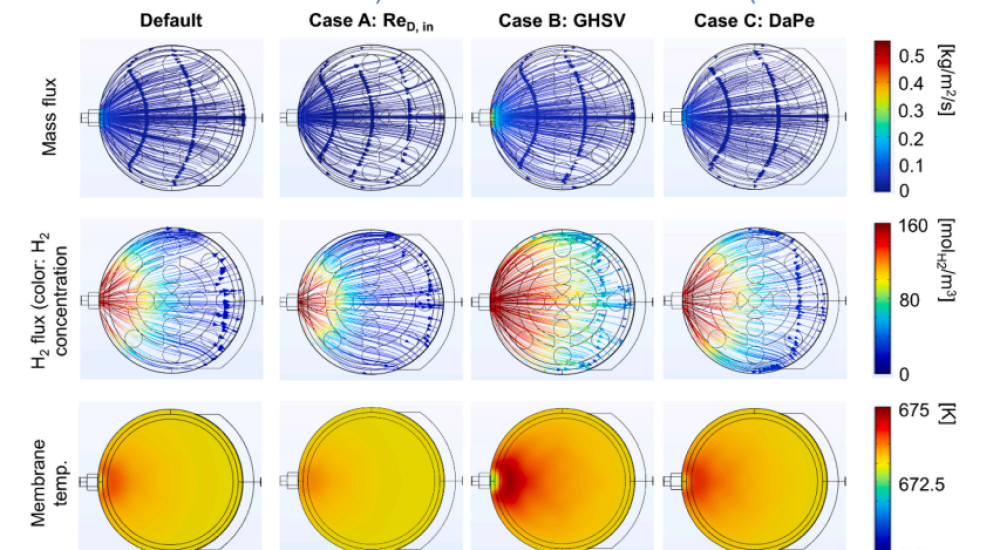
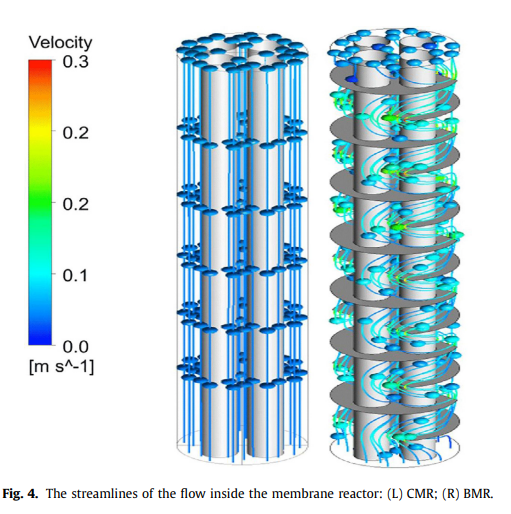
We utilize cutting-edge Computational Fluid Dynamics (CFD) to visualize and control the complex, “invisible” phenomena within energy systems. Unlike PEMFCs, which often face challenges with two-phase flow and water management, SOFCs and fuel processors operate primarily in the gas phase, making CFD an exceptionally powerful and reliable tool for high-fidelity performance prediction.
By integrating fluid flow, heat transfer, and multi-component chemical reactions into sophisticated mathematical models, we precisely analyze internal temperature distributions and concentration gradients. This allows us to investigate concentration polarization—a phenomenon difficult to identify through experimentation alone—and to maximize hydrogen production efficiency by designing optimized baffle structures. Our simulation-driven approach effectively reduces experimental trial-and-error, leading to the development of robust, high-efficiency reactor and stack designs.
System Dynamics & AI Strategy
The overall performance of a fuel cell is determined not only by individual components but also by the synergy of the integrated system. Our laboratory (NECS Lab) excels in the Dynamics Simulation of integrated systems, particularly those combining fuel processors with SOFCs. Leveraging our high-fidelity hybrid system models, we develop intelligent operation strategies designed for real-world commercialization.
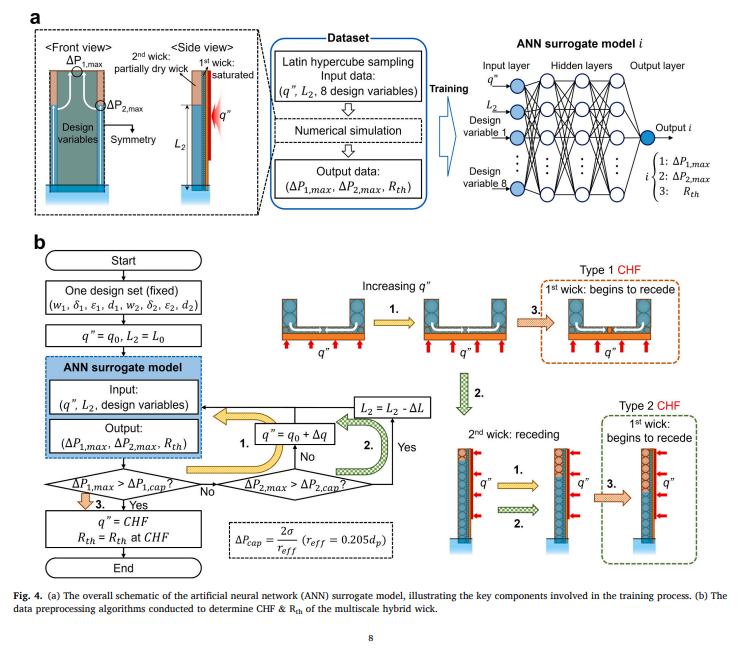
We are pioneering the intelligence of energy systems by integrating traditional mechanical engineering models with Artificial Intelligence (AI). By employing Artificial Neural Networks (ANNs), we precisely predict critical operating thresholds, such as the dry-out points of hybrid wicks.
Furthermore, we utilize Reinforcement Learning (RL) algorithms to derive optimal economic operation strategies for Energy Storage Systems (ESS) within smart grids, maximizing both the reliability and cost-effectiveness of next-generation energy infrastructures.